
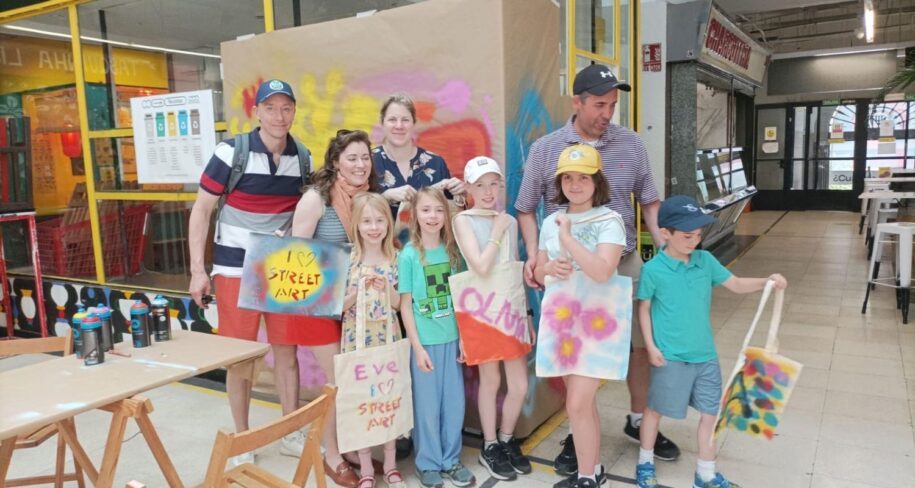
How would you describe someone who teaches street art for kids? An art educator, a bad influence, or a bridge to one of the most misunderstood movements of the last century? These are fair questions, and we hear them regularly. At Cooltourspain, we have thought hard about all of them. For this article, we spoke with Javier García, CEO of Cooltourspain and a qualified primary school teacher specialising in English. He covers everything you need to know about graffiti and urban art for younger audiences.
- Where can kids paint graffiti in Madrid without getting fined?
- What does a graffiti tour for kids actually look like?
- Who are Spain’s most famous street artists?
What is graffiti? Defining street art for kids
To define graffiti for a younger audience, it helps to start at the very beginning. The word traces back to the Greek “grapho”, meaning to engrave or to write. In its simplest form, a graffiti is an inscription or signature made in a public space, generally without permission. And despite what many people assume, spray paint is not the only tool involved.
For many of us at Cooltourspain, graffiti means far more than a tag (the artist’s signature, in street art language). It is an artistic, cultural, and social movement with millions of followers worldwide. You do not need to be an expert to get started by the way. All you really need is the willingness to learn. Behind this urban community lie stories, friendships, and some of the most creative hours a young person will ever spend.
A brief history of street art
If you are researching street art for kids, here is a fact that surprises most people: street art is far older than you might imagine. The etymology of the word gives you a clue. If it traces back to Greek, how many centuries ago do you think people were already leaving marks on walls?
On one hand, we can trace this impulse all the way back to cave paintings. Romans and Greeks were also scratching inscriptions into stone using a stylus they called a graphito. Beyond the ancient world, even the Second World War saw this creative instinct at work, with decorative markings applied to planes and bombs by soldiers far from home.
Within contemporary history, graffiti as we know it was born in the United States during the late 1960s and early 1970s. From there, it spread internationally and reached Madrid around 1980, right alongside the cultural explosion known as the Movida Madrileña. Do you know the story of Juan Carlos Argüello, better known simply as Muelle?
Where can kids paint graffiti legally in Madrid?
Today, street art is popular with young people and adults alike. If you want to avoid fines that range from €600 to €3,000, our graffiti workshops are the answer. Participants paint with spray cans in a safe and fully supervised environment. We specifically recommend this experience for children between 6 and 12 years old.
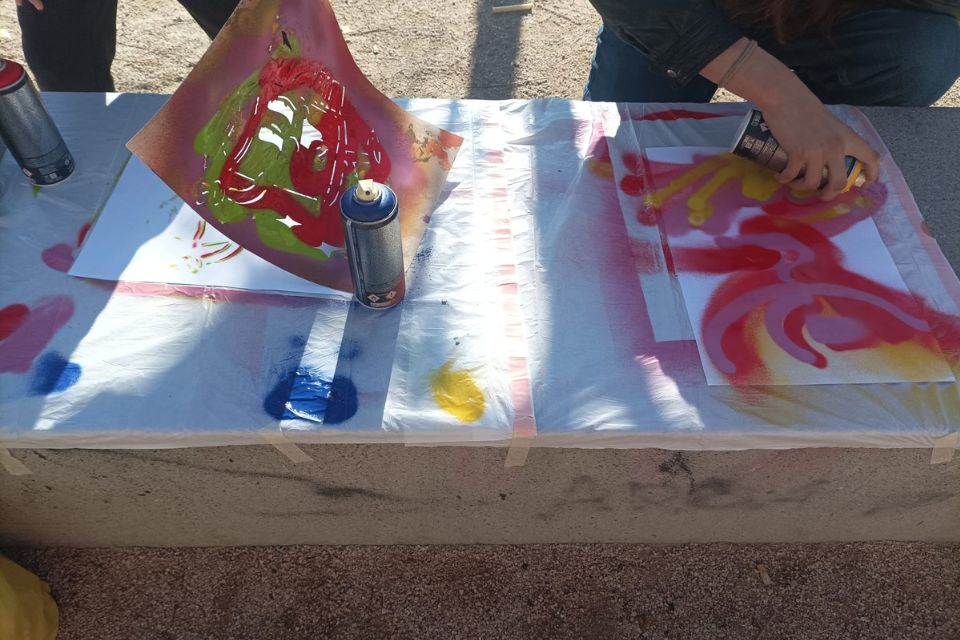
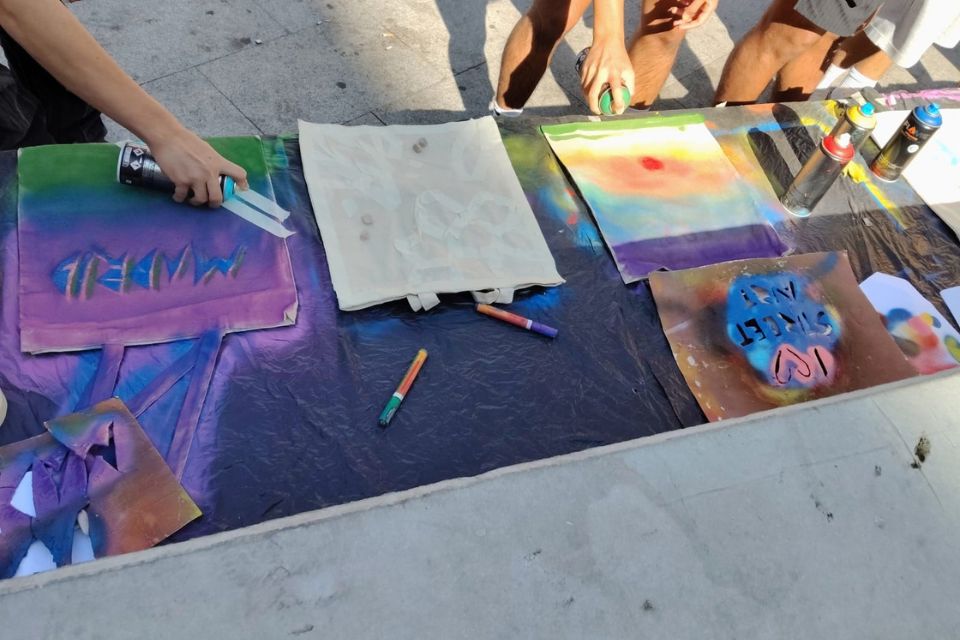
We work outside and on A3 papers, in a park or in a square, a great experience for anyone who wants to develop their line work, colour-fill technique, and blending skills. It works equally well for children who have already experimented with watercolours or oils, and for those who have never had any contact with urban art before. Both groups always leave with something they are genuinely proud of.
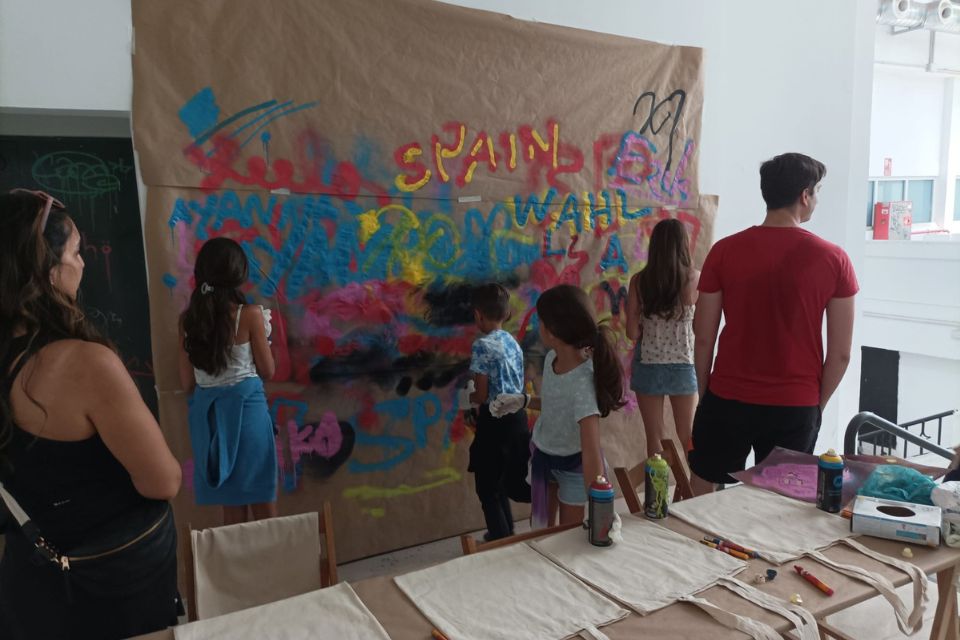
Graffiti classes are also available for primary schools. In addition, we have developed a dedicated programme for alternative birthday parties in Madrid, for children who want something genuinely different. Participants work with plastic paint, masking tape, rollers and brushes, spray cans, and markers, with all materials provided and adapted to the age group.
How to paint your first graffiti piece
Painting a graffiti piece is not as complicated as it looks. You can start with crayons or basic markers, but the most important ingredient is attitude. That part is non-negotiable. Once you have your materials ready, it comes down to practice, practice, and more practice. Consistency, in the end, is what has made some of Spain’s most celebrated street artists what they are today.
You will also find step-by-step tutorials on YouTube that walk beginners through the process in clear stages:
- Sketch your design on paper with a pencil.
- Fill in the background colour.
- Add any figures you want: bubbles, drops, crowns, ovals, arrows.
- Work on the interior of the letters.
- Finish with the powerline, which is the outline that frames all the shapes you have created.
These same steps apply directly on a wall. Simply swap the paper for a surface and the markers for spray cans. Do you know which graffiti supply shops are worth visiting in Madrid? In the capital, we recommend Writers Madrid and Montana.
What makes graffiti for kids distinctive
When it comes to street art for kids, several important points deserve to be raised. From Cooltourspain’s perspective, these are the ones that matter most:
- Graffiti and urban art are not the same thing. Which came first, the chicken or the egg?
- Street art can become a professional career. We can say this with complete confidence: people do make a living from it.
- Graffiti artists are not criminals. Like every social movement, this one has its critics and its supporters.
- Local authorities spend considerable energy pursuing street artists, while doing very little to create legal spaces for free creative expression. We want dedicated mural walls in every district of Madrid.
Think graffiti is a complete waste of space? Tell us. Do you have a crew of artists who want to get their work known? Get in touch and share your opinion.
The benefits of street art for kids
When street art comes up in conversation, many people are quick to find fault with it. We, on the other hand, are firmly in its corner. From an educational, social, and cultural standpoint, here is why we believe in it:
- It promotes real human interaction. Participants step away from screens and build genuine connections. They interact physically with other individuals and communities, in person, in the street, with no algorithm in between.
- It is genuinely multidisciplinary. When you stand in front of a wall and plan what to paint, you draw on natural sciences, spatial reasoning, and even mathematics. You need to measure distances and proportions to get a graffiti piece right, after all.
- It builds empathy. While graffiti celebrates individual expression, many urban art murals address solidarity, anti-racism, and equality. Do you know of any murals in your city that have had a real impact on the community around them?
As you can see, urban art contributes to a better world in a number of specific ways. Each of us, with our own small contribution, can add something meaningful to the neighbourhood we live in.
Guided graffiti tours for kids in Madrid
If all of this has sparked your curiosity, wait until you hear about our dedicated graffiti tour in Lavapiés. On this walk, we cover stories and lesser-known facts about Madrid’s graffiti community. Together, we explore the artistic interventions that have transformed Lavapiés, one of the city’s most multicultural and visually rich neighbourhoods. Several street art festivals have left permanent marks here, and there is always something new to discover.
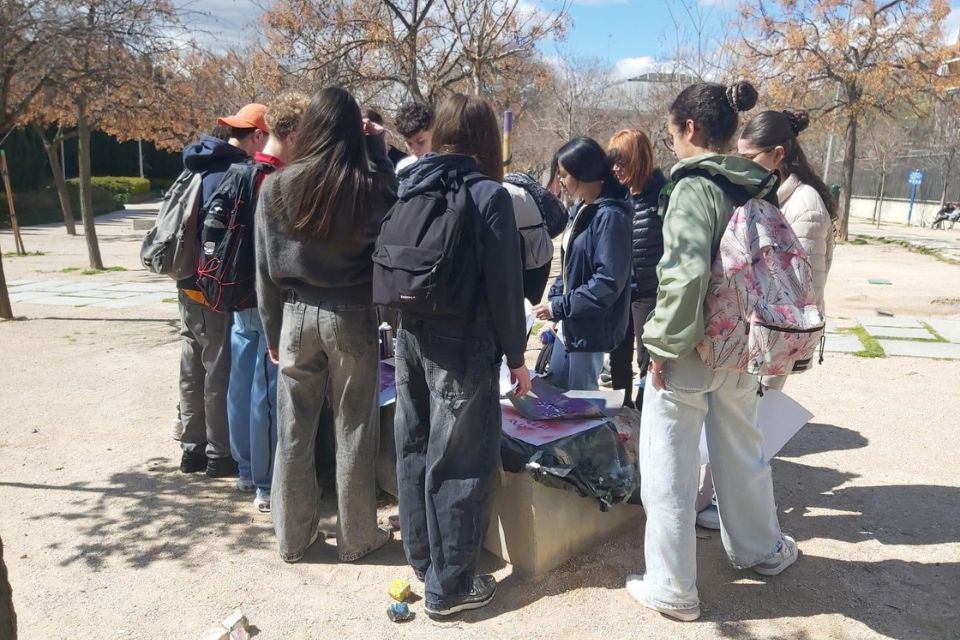
Whether you are in the 6-to-12 age range or the 12-to-17 bracket, we have a programme designed around you. Beyond the walking tour in Madrid, you will also have the opportunity to create your own graffiti piece using stencils and water-based spray cans. This hands-on activity takes place mid-tour, in a park on Calle Embajadores called Casino de la Reina.
The tour starts at the entrance to the Teatro Valle Inclán (Calle de Valencia, 1), directly opposite Lavapiés metro station. The route then follows Calle Argumosa, Doctor Fourquet, Valencia, Miguel Servet, and Embajadores. After approximately two hours on foot, you arrive at Plaza de Cascorro, next to La Latina metro.
The most famous street artists in Spain
Fortunately, some of the most important street artists working today are Spanish. For a broader look at the national scene, our guide of spanish street art is a solid starting point. Here, though, we want to highlight three names that any young art lover should know.
First, there is Okuda, a Cantabrian artist who has taken part in graffiti projects for children in Spain. Today, his profile is such that he spends most of his time travelling, painting large-scale building facades, working on campaigns for major brands, and producing pieces for contemporary art galleries around the world.
Another essential name is Suso33, with a long career at the centre of Spain’s urban art scene. He was instrumental in bringing major American graffiti figures to Spain and organised several landmark exhibitions dedicated to street art. Like many artists of his generation, he started illegally. From those early beginnings, he became one of the most internationally recognised Spanish artists alive today.
A third figure worth knowing is Antonyo Marest, from Alicante. His Mediterranean vision fills walls with vegetation, colour, and figurative forms wherever he goes. His work has appeared in Panama City, Miami, Madrid, and many other cities across the world.
What Cooltourspain thinks about street art for kids
Methodology matters to us. When it comes to street art for kids, we try to make every session as accessible and enjoyable as possible, and we always choose materials genuinely suited to the age group. You cannot hand a 300ml spray can to a six-year-old and expect them to control it comfortably with one hand. We know that from experience. Above all, we believe in teaching young people early on where they can and cannot paint in the city. Understanding the rules is what makes creative freedom meaningful.
We also want to use this space to make a public appeal to Madrid’s city council: please designate free mural walls in all 21 districts of the city. We want to paint without getting into trouble with the police. That is not too much to ask.
Get in touch with us at +34638399784 or by email at info@cooltourspain.com.
Leave a Reply