
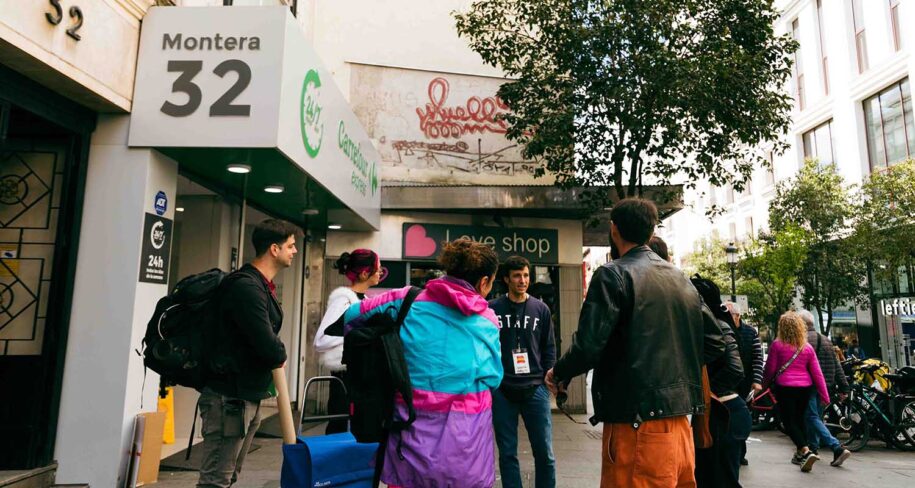
Every year, numerous students participate in curriculum-related school trips to Madrid. These experiences outside the classroom include visits to the Prado Museum, or the Royal Palace. However, what’s the percentage that guided visits focused on art, culture, and history take on the whole holidays? Are they engaging and enjoyable for children and teenagers of all ages?
As per the 2024 report from the Spanish Department of Education, our country received 180.563 international students who joined a degree course. Could there exist a better way to experience Madrid than through an arts and language field trip?
Here are a few paths that would allow students to explore a unique aspect of the city:
- Street Art Tour in Lavapiés
- How much does a school trip to Madrid, Spain cost?
- Urban Art & Graffiti Workshop
What’s the importance of Lavapies district in the school trips organized to Madrid, Spain?
Firstly, it’s important to note that Lavapiés is one of the city’s most diverse neighborhoods. We begin with a fundamental element of a thriving community: respect. In this sense, the school trips to Madrid foster an idea of belonging to an inclusive and supportive environment.
The primary aim of our street art tour around Lavapies is to stimulate critical thinking through art interpretation. How many students aged 6 to 16 can discern the themes or intentions behind a street art piece?
FYI, when groups have 20 or fewer students, we convene at the entrance of Teatro Valle-Inclán (Calle de Valencia, 1). For larger groups, we assemble at the Reina Sofía Museum of Modern Art (Calle Santa Isabel, 52).
Where can you discover the best street art around Embajadores neighborhood?
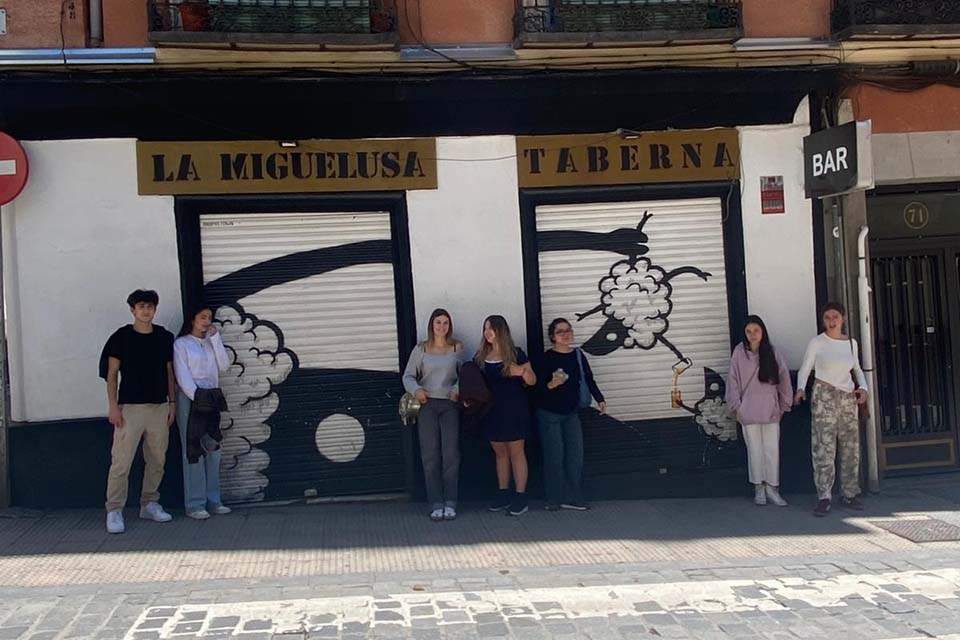
Certainly, the most striking murals can be found around Calle Embajadores. Students can appreciate the artworks from CALLE Lavapies festival on the business metal shutters (Calle Argumosa for example). During our school trips to Madrid, we concentrate on individual interpretation and group discussion regarding these public artworks.
We also visit Calle Doctor Fourquet, which showcases murals from the URVANITY Art Festival, recognized for featuring internationally acclaimed urban artists. A notable example is D*Face’s mural located at Calle Embajadores 21.
What additional experiences do these school trips to Madrid enjoy apart from the classic walking tours?

While students typically enjoy any school trips to Madrid, they particularly appreciate experiences that allow them to engage physically, create, and interact. Therefore, we’ve incorporated a hands-on component into our activities.
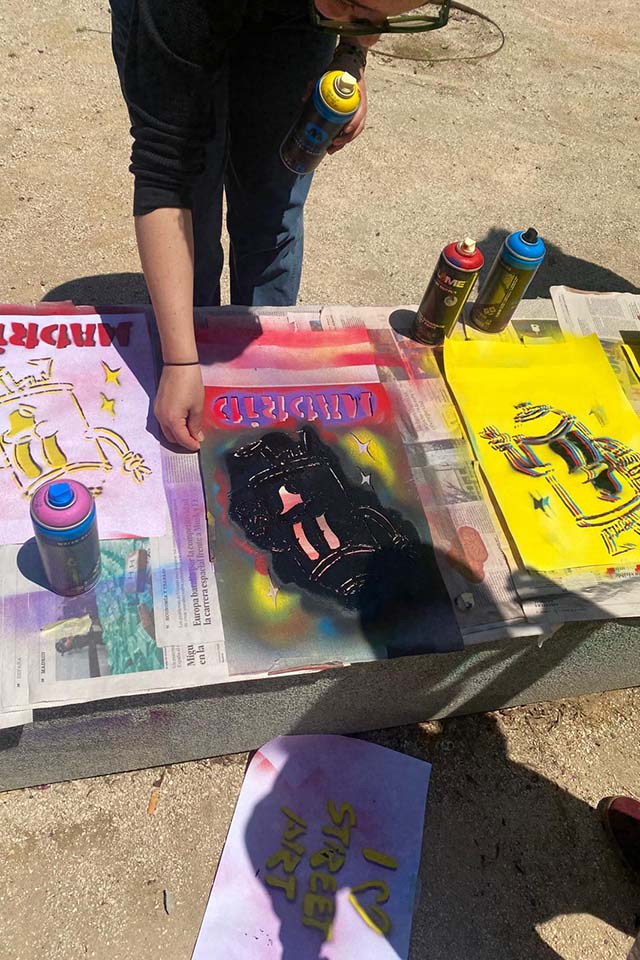
A mini urban art and graffiti workshop occurs during the two-hour walk. Here it’s when students create and spray their own stenciled graffiti using templates and water-based spray paint. One of our guides assists them throughout the process.
The outcome? Each student leaves with a personalized piece of art. Pretty cool, right?
How are the high school trips in Malasaña (Madrid) organized?
Similar to our Lavapiés excursions, our school trips to Madrid around Malasaña district are entirely based on walking. The route is manageable, featuring an easy walk and numerous stops. These experiences cater to all educational levels—from elementary students to those nearing college.
For every 13–15 students, a Cooltourspain guide and a school coordinator accompany the group. This student-to-guide ratio promotes effective and individualized learning. FYI, it’s mandatory that under 18 years ols students count with an adult from their institution at all times.
Introduction to local historty: La Movida Madrileña + local graffiti
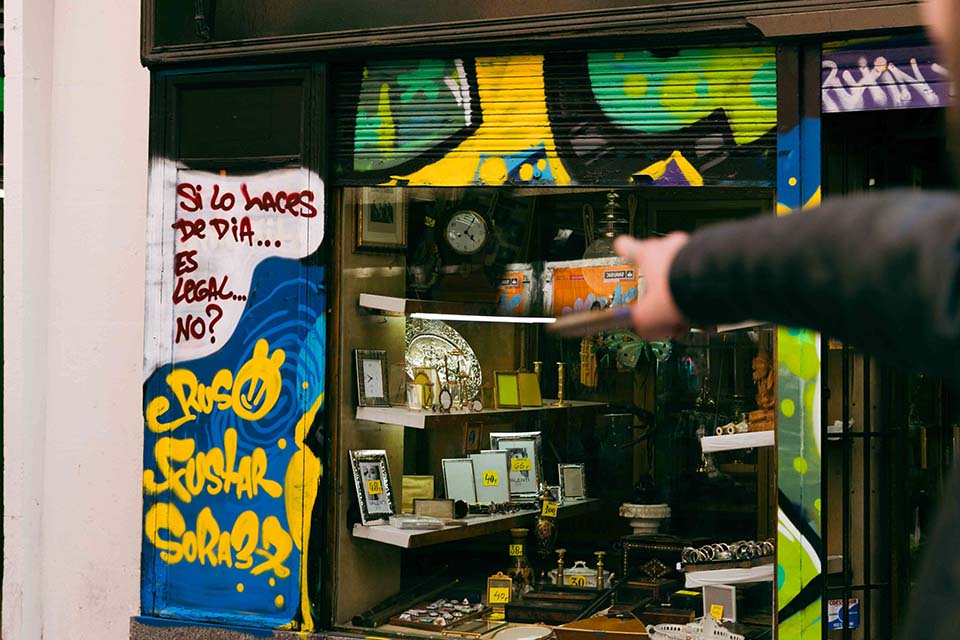
Spain’s history encompasses significant social transformations. And so do our school trips to Madrid operate. Moreover, textbooks often highlight the nation’s shift from dictatorship to democracy in the late 70s and 80s. This period also saw the emergence of a countercultural phenomenon known as La Movida Madrileña.
Malasaña was the heart of this artistic and social upheaval. Young individuals, often marginalized for their perspectives, transformed music, culture, sexuality, and urban existence.
A notable figure from this era was Juan Carlos Argüello, known as Muelle (1966–1995), a groundbreaking street artist in Madrid. His signature, which included his name and a spiral-ended arrow, marked the origin of Madrid’s graffiti scene, referred to as “flecheros”.
Meeting point and route info for the school trips to Madrid, around Malasaña district
Our tour begins by Pasaje de la Caja de Ahorros, located next to Puerta del Sol. From this point, the school trips to Madrid split into smaller groups to discover one of Madrid’s neighborhoods, that blends modernity with tradition, in a sustainable and socially responsible way.
The route includes Tribunal, Malasaña, San Bernardo, and Noviciado, concluding at Plaza de España, which provides great access to the metro. If the group arrives by school bus, both the start and finish locations have appropriate drop-off and pick-up spots.
Add a graffiti & street art workshop to the school trips to Madrid
Students appreciate chances to engage with materials and express their creativity. So, why not let them try their hand at a spray can—as part of their education, of course? Our school trips to Madrid feature urban art workshops aimed at enhancing cognitive, social, and artistic skills.
Students work together to design and produce their own art pieces. Depending on the size of the group, the workshop can be held at El Mercado de San Fernando or another larger location.
Urban art workshop details
With the increasing popularity of street art, more public and private institutions opt for a school trip to Madrid around urban culture. Specially, those participating in our educational programs. These trips merge learning with practical creative activity.
Initially, students cut stencils from plastic sheets, then they transfer their designs onto a 100% cotton tote bag or paint over a t-shirt using water-based spray paint in an array of colors.
The entire session lasts about two hours and can be conducted in either English or Spanish. Students may also have the opportunity to paint their stencils directly onto specific walls at the venue.
Mini graffiti course at school or off-site
This workshop helps students understand and respect the public space around them. Professional graffiti artists from Madrid lead the sessions and teach students where it is and isn’t appropriate to paint.
These artists—who once tagged trains—now deliver motivational talks and complete commissioned works.Students learn to create their own tags (signatures) and throw-ups (bubble letters) in a safe, structured setting.
What does Cooltourspain think about the school trips to Madrid?
With our educational background, our team is prepared to teach not only art but also foreign languages. This is why the school trips organized by Cooltourspain come with real classroom experience. In only four years, several team members have moved from teaching in schools to leading students in a fun, creative, and relaxed atmosphere. And we’re just beginning.
Would you like to help us continue to expand? Contact us at +34 638 399 784 or info@cooltourspain.com.
Still, these are other questions that groups frequently ask on the internet:
How much is a trip to Madrid Spain for a student group?
Accommodation for educational groups may vary from 65 to 75€ per night, and you should add food for approximately 15-20€ per meal. If you add a guided visit which costs 15€/student, you could calculate an average of 100€-115€, per student and day.
Do school trips need a passport to Spain?
Please check the official government’s website for further information. It will all depend on your country of origin.
What to take on a school trip to Madrid, Spain?
You should always bring euros in notes, an electric charger which allows you to use the national system, and your passport. However, do not get to the streets with it on your wallet. Leave it at your hostel/hotel/accommodation.
Leave a Reply